
A chain, not a guess
Routes the task, announces the chain in one line, runs step 1 and records what ran.
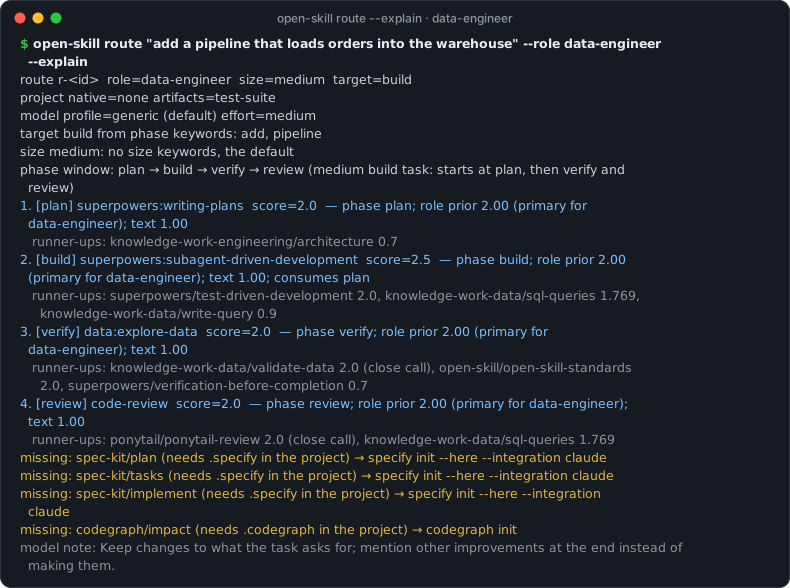
- plansuperpowers:writing-plans2.0
- buildsuperpowers:subagent-driven-development2.5
- verifydata:explore-data2.0
- reviewcode-review2.0
Open standard · agent-agnostic · MIT
Pick the right Agent Skills for each task, in the right order, with the reason for every step. A reference implementation ties together superpowers, BMad Method, spec-kit, codegraph, Anthropic's skills and more, without copying any of them.
01 · why
A typical setup has 100+ overlapping skills. Open Skill Standard adds the missing layer: which role a skill serves, which phase it acts in, and which artifacts it consumes and produces. From that, a router builds a short, ordered, explained chain.
Agents pick skills by matching descriptions. Three build workflows and several reviewers that sound alike make them load the wrong one or miss the right one.
Claude Code budgets the skill listing at about 1% of the context window and drops the least-used descriptions first, so matching gets worse exactly when you install more.
02 · what you get
Upstream skills are described as metadata and installed with their official commands. The router reads that metadata; your agent runs the chain.
Routes the task, announces the chain in one line, runs step 1 and records what ran.
Checklists, general and for each of the 28 roles.
codegraph, Context7, schemas, the web or your notes, before guessing.
Lessons and preferences live in ~/.open-skill/ and shape future routes. Nothing leaves your machine.
03 · how it works
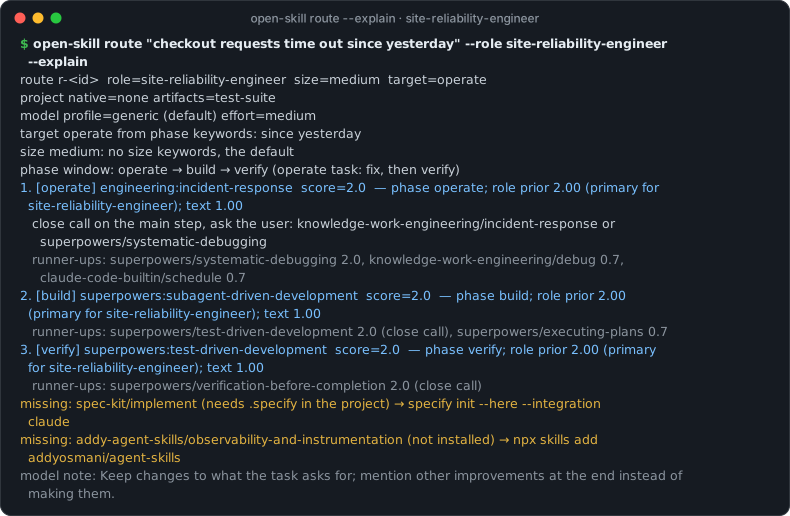
route --explain and route --why-not <skill> show every decision.

Both diagrams are generated from the code and the registry on every change, so they cannot drift.
04 · roles
A role pack states the role's characteristic risk, its principles, the project files that suggest it, and its primary and alternative skills per phase.
A site reliability engineer who reports that checkout requests time out starts with debugging, not with a plan. The data engineer in the terminal above starts with a plan.
05 · parallel sessions
Each session declares the paths it works on. After an edit, open-skill session update refreshes one shared Graphify graph and warns, never blocks, when the change reaches another session's scope.

06 · measured
The router is compared with baselines and ablations using the checks CI runs. Every number is reproducible with python -m open_skill.benchmark.

07 · the skill graph
Artifacts, requirements, conflicts and recommending roles for each of the 196 skills. Filter by role, phase and source; it works offline and with the keyboard.

08 · get started
Or in any of the 10 agents that load Agent Skills (see the list). Upstream frameworks are described, then installed with their own commands:
# 1. Install the skills (Claude Code); or: npx skills add VoKhoiNhon/open-skill-standard -g
/plugin marketplace add VoKhoiNhon/open-skill-standard
/plugin install open-skill@open-skill-standard

# 2. Tell it your role(s); this also seeds starter knowledge for them
uvx --from git+https://github.com/VoKhoiNhon/open-skill-standard@v0.7.2 open-skill init --role data-engineer=0.7 --role data-analyst=0.3

# 3. In your agent, inside any project
/open-skill-router add a pipeline that loads orders into the warehouse
Read the specification, write an adapter for your own skills, or add a role pack for your team.